Municipal Support for Advancing Data-Driven Management of Community-based Integrated Care: A Cluster Randomized Controlled Trial
【Executive Summary】
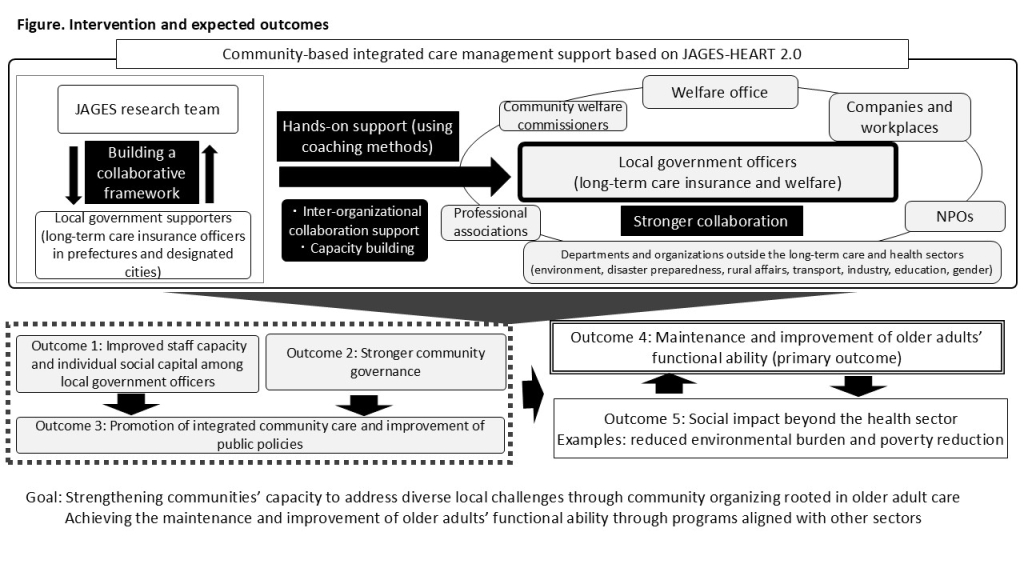
The MUSUBI Study is acluster randomized controlled trial that examines whether hands-onsupport (using coaching methods) for local governmentofficers can enhance the effectiveness of community-based integratedcare in Japan. Building on the Japan Gerontological EvaluationStudy (JAGES) framework, the project supports municipalities inutilizing local health data, facilitating inter-sectoral collaboration, andadopting effective community initiatives.
Municipalities are randomly assigned toreceive either coaching support or standard practice, allowing rigorousevaluation of outcomes. The study primarily assesses functional abilityamong older adults and secondarily examines improvements in municipal staffcapacity, local governance, policy innovation, and wider social impacts—such aspoverty reduction, disaster preparedness, or environmental benefits.
By implementing the JAGES-HEART systemin collaboration with prefectural governments, the MUSUBI Study aimsto establish a scalable, evidence-based model for promoting integrated,equitable community care—contributing both to Japan’s population ageingpolicies and to global discussions on sustainable community health systems.
Background
Japan’s community-based integrated caresystem is designed to enable people to live in familiar settings with dignitythroughout their lives.
This system provides a locally adapted framework that reflects regionalcharacteristics.
Successful implementation requires effective use of local health data andcommunity resources, as well as strengthened collaboration among residents,local governments, professionals, and private service providers—transcendingtraditional sectoral boundaries. At its core lies the principle ofcommunity-led primary health care, aiming to build inclusive and co-creativesystems.
Addressing health inequalities arising from the social determinants of health(SDH)—including urban–rural divides, income disparities, and variations inhousehold composition (e.g., living alone)—is another key policy goal.
The MUSUBI Study (Municipal Support for AdvancingData-Driven Management of Community-Based Integrated Care: ACluster Randomized Controlled Trial) is a large-scale social experimentdesigned to evaluate whether providing hands-on support (using coachingmethods) to local government officers in developing and implementingcommunity-based integrated care can strengthen their capacity forevidence-based decision-making and ultimately improve the health and well-beingof older residents.
Earlier studies have indicated that support in:
- Utilizing data from community needs assessments for diagnosis and evaluation, and
- Facilitating intersectoral collaboration through community-based integrated care promotion platforms may enhance community participation among older men and contribute to reduced mortality risk. These effects have been observed across income levels, suggesting potential benefits for both overall population health and reduction of inequalities.
Related findings
- Municipal support initiatives reduced the mortality risk among older men to 0.92 through data-driven community care promotion.
Haseda M, Takagi D, Stickley A, Kondo K,& Kondo N. (2022). Effectiveness of a community organizing intervention onmortality and its equity among older residents in Japan: A JAGESquasi-experimental study. Health & place, 74, 102764. DOI: 10.1016/j.healthplace.2022.102764
- Participation in community activities increased by 8% over three years following the provision of JAGES regional data, with an additional 2.5% increase when enhanced municipal support was provided.
Haseda M, Takagi D, Kondo K, Kondo N.(2019). Effectiveness of community organizing interventions on socialactivities among older residents in Japan: A JAGES quasi-experimental study.Soc Sci Med; 240:112527. DOI: 10.1016/j.socscimed.2019.112527
However, earlier evaluations had several methodological limitations:
- Municipalities were not randomly assigned.
- Spillover effects beyond the health sector were not examined.
- Interventions were researcher-led, leaving uncertainty regarding effectiveness when implemented by prefectures (e.g., public health centers), which are expected to serve as primary support providers.
To address these gaps,the MUSUBI Study employs a cluster randomized controlled trial (cRCT)design at the municipal level.
Participating municipalities were randomly assigned to either receive coachingsupport or continue existing practices without such support.
Prefectural governments and designated cities collaborate with the researchteam to implement the intervention, enabling a robust comparison betweengroups.
The study is registered with the UMINClinical Trials Registry as follows:
Title: ヘルシー・エイジングの推進へ向けた自治体への伴走型支援による地域組織化の効果判定:クラスターランダム化比較試験
UMIN Trial ID: UMIN000054471
Registry URL: https://center6.umin.ac.jp/cgi-open-bin/ctr/ctr_view.cgi?recptno=R000062075
Coaching support covers the following key activities:
- Community needs assessment, goal setting, and evaluation
- Promotion of intersectoral collaboration (e.g., coordination of community care meetings)
- Human resource development
- Adaptation and scaling of successful practices from other regions
These components align with the guidebook:"Achieving Healthy Ageing through community development: a guidebook forsupporters”.
The MUSUBI Study leverages the extensive field infrastructure of theJapan Gerontological Evaluation Study (JAGES) and utilizes JAGES-HEART, a tooldeveloped from the World Health Organization’s Urban Health Equity Assessmentand Response Tool (Urban HEART) by the WHO Centre for Health Development.
By implementing JAGES-HEART as a prefecture-led support framework andrigorously evaluating its implementation process and outcomes, the project aimsto establish a globally relevant model of community-based integrated careaddressing rapid population ageing—originating from Japan.
PICO Framework
- Population (P): Residents aged 65 years and older
- Intervention (I): Coaching support for municipal staff based on JAGES-HEART (data provision + facilitation of cross-sector collaboration)
- Comparator (C): Standard integrated community care promotion (data provision only)
- Outcomes (O):
Primary outcome: Functional ability among olderadults
Secondary outcomes:
- Skills and social capital of municipal staff
- Local governance and inter-sectoral collaboration
- Public policy improvements (e.g., improvement in Long-term Care Prevention and Daily Living Support Progress (LCPDLSP) scores)
- Broader social impacts beyond healthcare (e.g., environmental, economic, and community-level effects)
Related Tools
To assist ongoing initiatives by researchers and practitioners collaboratingwith municipalities, the research team has developed a new resource, theSupport Handbook. This tool addresses common challenges such as:- Monitoring and sharing progress in support activities
- Documenting and transferring tacit knowledge to other regions
The handbook serves as a practical guidefor designing, implementing, and evaluating community support activities in asystematic manner.
Key Features
- Progress visualization and information sharing: A checklist-based structure covering essential actions (e.g., data utilization, inter-organizational collaboration, human resource development) facilitates transparency and coordination.
- Quality improvement through PDCA cycles: Each action incorporates evaluation mechanisms to support continuous learning and refinement.
- Evidence generation from practice: Documentation of support activities produces valuable data for analyzing effective approaches. In participating municipalities, integration with JAGES-HEART further enhances the evidence base.
Publications
●Ho DSM, Yamaguchi K, Ide K, Kiuchi S,Kondo N, Aida J. Municipal Governments' Long-Term Care Prevention Efforts andHomebound Status of Older Adults: A Three-Year Cohort Study in Japan. GeriatrGerontol Int. 2025 Nov;25(11):1580-1590. DOI: 10.1111/ggi.70209
●Nogawa F, Haga C, Kojima K, Ojima T. (inpress) Training needs of community comprehensive support center staff tostrengthen community-based integrated care, Nihon Koshu EiseiZasshi(JAPANESE JOURNAL OF PUBLIC HEALTH). https://doi.org/10.11236/jph.25-059
●Nishio M, Haseda M, Inoue K, Saito M,Kondo N. Measuring functional ability in Healthy Ageing: testing its validityusing Japanese nationwide longitudinal data. Age Ageing. 2024 Jan2;53(1):afad224. DOI: 10.1093/ageing/afad224.
Contact
Department of Social Epidemiology
Graduate School of Medicine, Kyoto University
https://socepi.med.kyoto-u.ac.jp/contact_us


